TABLE OF CONTENTS
- Product Overview
- Quick Reference
- Parts & Controls
- Checking the Battery Level
- Charging a Device with the Built-in Type-C Cable
- Charging a Device Through USB-A
- Charging a Device Through the USB-C Port
- Recharging the Luxcell UNO 10
- Charging Two Devices
- Understanding the Dummy Type-C Slot
- Getting the Best Charging Performance
- Safety & Care
- Still stuck?
Product Overview
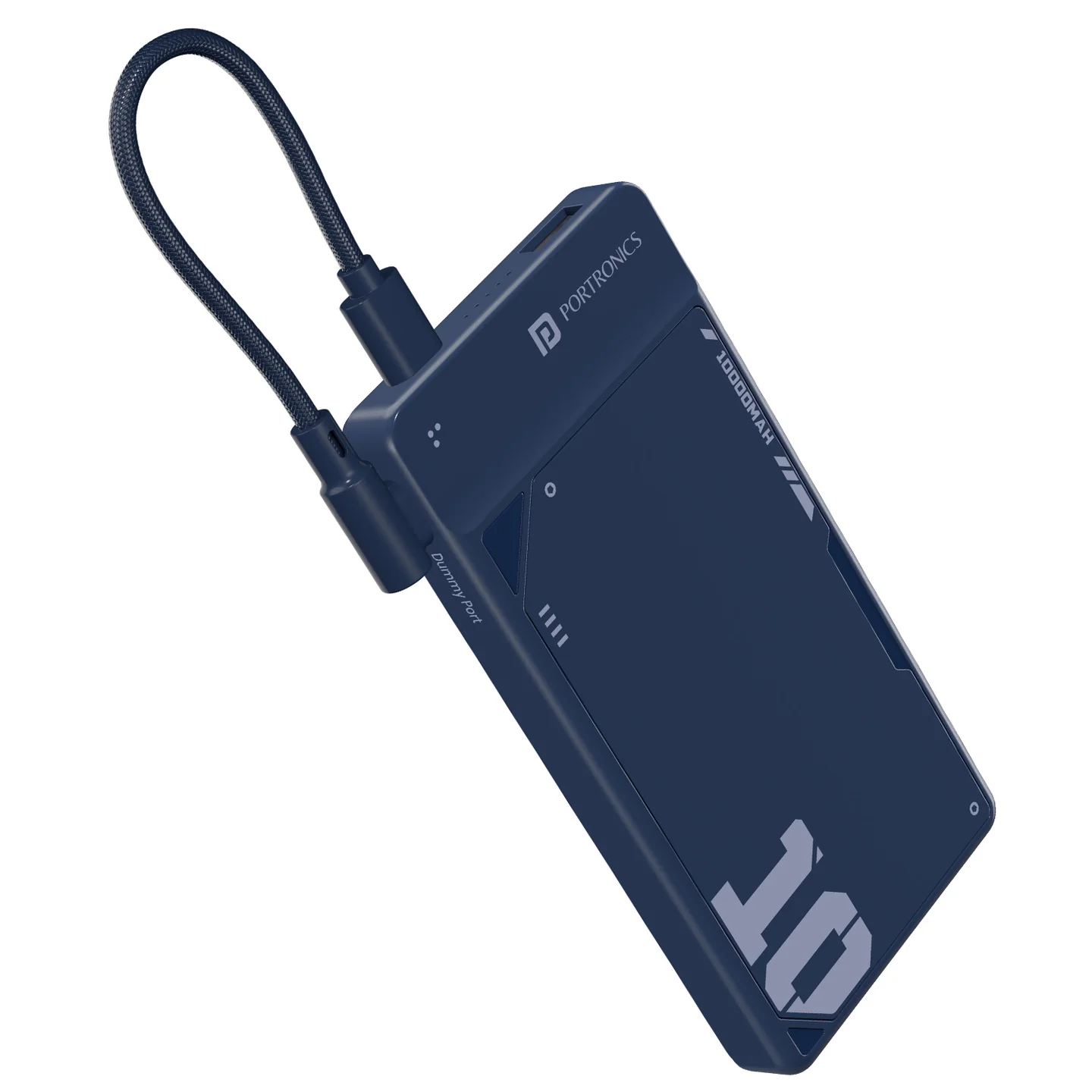
The Portronics Luxcell UNO 10 is a 10,000mAh power bank with a detachable built-in Type-C cable, a USB-A output and a bidirectional USB-C port. It supports fast charging up to 22.5W and includes an LED indicator to show the remaining battery level.
Quick Reference
| Feature | Details |
|---|---|
| Product | Portronics Luxcell UNO 10 |
| Capacity | 10,000mAh |
| Maximum Total Output | Up to 22.5W |
| Built-in Cable | Detachable USB-C cable |
| USB-C Port | Input and output |
| USB-A Port | Output |
| Dummy Type-C Slot | Cable storage only; does not supply power |
| Battery Indicator | Four-LED level display |
| Colours / Product Codes | Blue: POR 2666; Black: POR 2810; Mocha: POR 2815 |
| Warranty | 12 months, as listed by Portronics |
Actual charging speed depends on the connected device, cable, charger and supported charging protocol.
Parts & Controls
| Part | Function |
|---|---|
| USB-A Output | Charges compatible USB devices |
| LED Indicator | Shows approximate remaining battery percentage and charging progress |
| USB-C Input/Output Port | Recharges the power bank or charges a compatible device |
| Dummy Type-C Slot | Holds the built-in cable when it is not in use; does not supply power |
| Wake-Up / Power Button | Displays the remaining battery level and activates the power bank |
Checking the Battery Level
- Press the Power Button once.
- The LED indicators show the remaining battery level.
- When the power bank is charging, the LEDs blink to indicate charging progress.
- When the power bank reaches the 76–100% range, all four LEDs remain on.
- If all four LEDs blink, the indicator is showing an abnormal status.
LED Battery Indicator
| Approximate Battery Level | LED 1 | LED 2 | LED 3 | LED 4 |
|---|---|---|---|---|
| 0–25% | Blinking | Off | Off | Off |
| 26–50% | On | Blinking | Off | Off |
| 51–75% | On | On | Blinking | Off |
| 76–100% | On | On | On | On |
| Abnormal indication | Blinking | Blinking | Blinking | Blinking |
The LEDs provide an approximate battery level, not an exact measurement.
Charging a Device with the Built-in Type-C Cable
- Carefully pull the built-in Type-C cable out of its storage slot.
- Connect it to the USB-C charging port on your phone or other compatible device.
- Check that the connector is seated properly and that charging begins.
- When finished, disconnect the cable gently and return it to the dummy Type-C slot.
The built-in cable is detachable and doubles as a convenient carry loop. Do not force the cable or connector.
Charging a Device Through USB-A
- Connect a compatible charging cable to the power bank's USB-A output.
- Connect the other end to your device.
- Check the device's charging indicator.
- Disconnect the cable carefully when charging is complete.
The USB-A port supports output profiles up to 22.5W, depending on device compatibility.
Charging a Device Through the USB-C Port
- Connect a compatible USB-C cable to the power bank's USB-C Input/Output port.
- Connect the other end to your phone or other compatible device.
- Check that the device indicates charging.
- Disconnect the cable carefully when finished.
The USB-C port supports both input and output. The separate dummy Type-C slot is only for storing the built-in cable and does not provide power.
Recharging the Luxcell UNO 10
- Connect a compatible USB-C charging cable to the power bank's USB-C Input/Output port.
- Connect the other end to a suitable USB-A or USB-C charger.
- The LED indicator blinks to show that charging is in progress.
- Monitor the battery level using the four-LED indicator.
- Disconnect the power bank when you are finished charging.
Use a good-quality compatible cable and charger. Input charging speed depends on the adapter and the supported charging profile.
Charging Two Devices
You can charge two compatible devices at the same time using the built-in Type-C cable and the USB-A output.
- Connect one device to the built-in Type-C cable.
- Connect the other device to the USB-A output.
- Check that both devices show charging.
- If charging is slower than expected, disconnect one device and test each output separately.
The maximum total output is 22.5W. The actual power supplied to each device depends on its charging requirements and the power bank's operating conditions.
Understanding the Dummy Type-C Slot
The side Type-C-shaped slot is a storage slot for the built-in cable, not a charging port. It does not provide power.
For charging:
- Use the USB-C Input/Output port to recharge the power bank or charge a compatible device.
- Use the built-in Type-C cable to charge compatible USB-C devices.
- Use the USB-A output for compatible USB-A charging cables.
Getting the Best Charging Performance
- Use a compatible, good-quality cable and charger.
- Confirm that the connected device supports the charging protocol you expect.
- Avoid using damaged cables or adapters.
- Check the LED battery level before charging another device.
- Disconnect one device if simultaneous charging is significantly slower than expected.
A 22.5W maximum rating does not mean every device will charge at 22.5W.
Safety & Care
- Charge the power bank on a flat, non-flammable surface.
- Do not charge it on a bed, sofa or near heaters or other flammable materials.
- Do not leave it charging unattended or overnight.
- Keep it away from direct sunlight, moisture and liquids.
- Keep loose metal objects away from the ports and cable terminals.
- Do not disassemble, puncture, crush or attempt to repair the power bank.
- Stop using it immediately if it becomes swollen, cracked, exposes wires or behaves abnormally.
- If the power bank is damaged, keep it away from flammable materials and seek safe handling/disposal guidance.
- Store it in a cool, dry place.
- Dispose of the power bank through an authorised electronic-waste collection point, not household waste.
Still stuck?
If the issue persists after performing all troubleshooting steps, please raise a support request.
Our support team will assist you further.
Support
- Visit: www.portronics.com
- Support Portal: support.portronics.com
Was this article helpful?
That’s Great!
Thank you for your feedback
Sorry! We couldn't be helpful
Thank you for your feedback
Feedback sent
We appreciate your effort and will try to fix the article